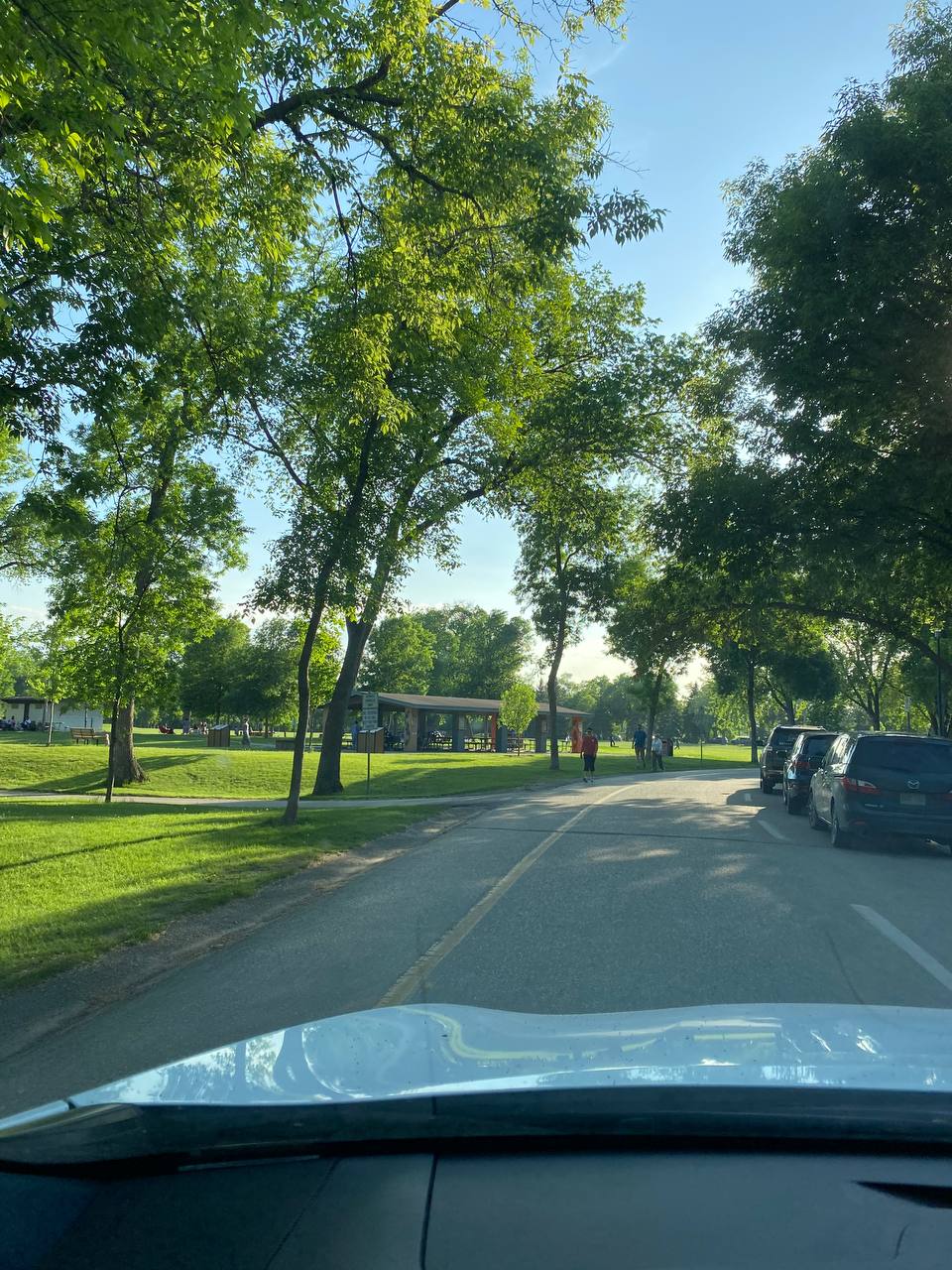
Long before I saw the barbecue, I could smell it.
Driving through Kildonan Park in north Winnipeg, you pass all the things that make the park a favourite gathering place: the river winding along the shoreline, open green spaces, playgrounds, picnic areas, and families spread across the grounds. Then, towards the end of the park road, you reach the large picnic shelters where the parties are held.
That’s where the smell would find you.
I remember being about eleven years old at a birthday party. Before we had even found a parking spot, the sweet and smoky scent of Filipino barbecue had already made its way into the car. Soy sauce, garlic, sugar, charcoal. It was unmistakable. Somewhere ahead, a family gathering was underway.
And somewhere, barbecue was on the grill.
For me, Filipino barbecue has always been more than food.
It is one of the first dishes I think about when I think about family gatherings. It is the smell of birthdays, summer afternoons, community picnics, and cousins running wild through the park while the adults stayed behind under the shelter.
The funny thing is that making Filipino barbecue is not nearly as exciting as eating it.
My mom first taught me how to make it. Her system was simple.
From the Grill
Inihaw is the Filipino term most often used for food cooked over a grill. While many people outside the Philippines think immediately of pork barbecue, inihaw can refer to everything from fish and chicken to vegetables cooked over charcoal.
In parts of the Visayas and Mindanao, you’ll often hear the word sinugba used in a similar way. Inasal, meanwhile, has become associated with a distinct style of marinated grilled chicken that traces its roots to Bacolod and Western Visayas.
Whatever the name, the smell of food cooking over fire usually means the same thing: people are gathering.
The process started the night before. Pork was cut into bite-sized pieces. Garlic was chopped. Sometimes onions joined the mix. Everything went into a marinade of soy sauce, calamansi or lemon juice, garlic, sugar, salt, and pepper before spending the night in the fridge.
The next morning came the part every kid tried to avoid.
Tusok.
The Filipino word means “to poke” or “to pierce,” and it describes the task of threading each piece of pork onto a bamboo skewer. Our assembly line was usually my mom, my younger brother, and me. Piece by piece, skewer by skewer. Sticky hands. Garlic under your fingernails. The smell following you for the rest of the day.
No kid wants that job.
Whenever I saw my mom or the Titas getting ready to make barbecue, I would suddenly become very interested in being somewhere else.
Looking back now, I appreciate the patience it required. There is an art to tusok. You don’t leave large gaps between the pieces. Too much exposed skewer and you risk burning the stick during cooking. Every piece has a place.
The payoff comes later.
Whether using charcoal or propane, the grill eventually heats up. A sheet of foil is stretched across the grates and carefully perforated with a fork. As a kid, that was one of my favourite jobs.
Then comes the moment everyone waits for.
The first skewer hits the grill.
The music starts.
The sizzle.
Juices drip through the tiny holes in the foil. Smoke rises. Sweet marinade caramelizes over the heat. Every now and then, a drop of rendered fat finds the flame and sends up another burst of smoke. The smell becomes impossible to ignore.
Turning each stick is its own exercise in patience. Too soon and it isn’t ready. Too late and you risk burning the sugars in the marinade. Every side needs attention.
When it is finally ready, the reward is immediate.
My mom’s barbecue always struck the perfect balance between sweet and savoury. The pieces weren’t oversized. There wasn’t too much sauce. The overnight marinade gave the pork a consistency that never disappointed. Every batch tasted exactly the way I hoped it would.
Maybe that’s why a simple pork skewer carries so much memory.
It wasn’t just the barbecue itself.
It was what the barbecue represented.
Whenever barbecue appeared, it meant people were gathering. It meant cousins were arriving. It meant birthdays, celebrations, and long summer afternoons where time seemed to disappear. I would grab a skewer, run off with my cousins, finish it in minutes, and return to bother my mom or the Titas for another one.
One stick at a time.
Again and again.
Lechon might get the attention. Lumpia often disappears first. Pancit shows up on nearly every table.
But for me, it’s always been the barbecue.
To this day, I still find myself holding back an extra skewer or two when nobody is looking. Maybe wrapped in foil. Maybe tucked safely onto the side of my plate.
Because if there’s one thing I’ve learned over the years, it’s this:
Filipino barbecue never lasts long.
And somehow, that’s part of what makes it special.


Leave a Reply