By Jose Soliven | Kucina
I didn’t expect a text message about old recipe books to lead me into another community’s heartbeat. I was simply asking a friend about dishes passed down through generations — the soups, stews, and preserved things that hold families together. But somewhere between “I. Love. Soup.” and reminiscing about pandemic tacos, Jelena introduced me to a word I had never heard before, a ritual that felt strangely familiar even though it belonged to a culture not my own.
Faspa.
A soft, warm word. A pause in the day. A table set not for a feast, but for connection.
And this is where the story begins.
A Book Every Family Knows
When I asked Jelena whether her family had recipes passed down from her grandmother, she didn’t hesitate.
“There’s a recipe book that circulates in the Mennonite community,” she said. “My grandma had it. My mom had it. Probably my great-grandma too.”
She was talking about The Mennonite Treasury — one of those community cookbooks held together by tape, flour dust, and decades of hands flipping through its pages. The kind of book that carries more than instructions. It holds the last names of neighbours, the handwriting of aunties, and the quiet authority of elders who rarely wrote anything down but somehow recorded everything important.
Inside are the foundational Mennonite dishes: soups, pickles, preserves, breads, rolls, jams — the everyday staples that build a table across time.
Her mom still uses the pickle recipe every year.
There is something beautiful in that continuity.
Not flashy. Not performative.
Just steady, reliable nourishment.
The Snack Between Meals That Is So Much More
While talking about recipes, Jelena mentioned something casually — almost a footnote — that stopped me.
“Mennonites have a meal between lunch and dinner called faspa.”
A meal between meals.
A built-in pause — not brunch, not merienda, not afternoon tea… but somehow a cousin to all of them.
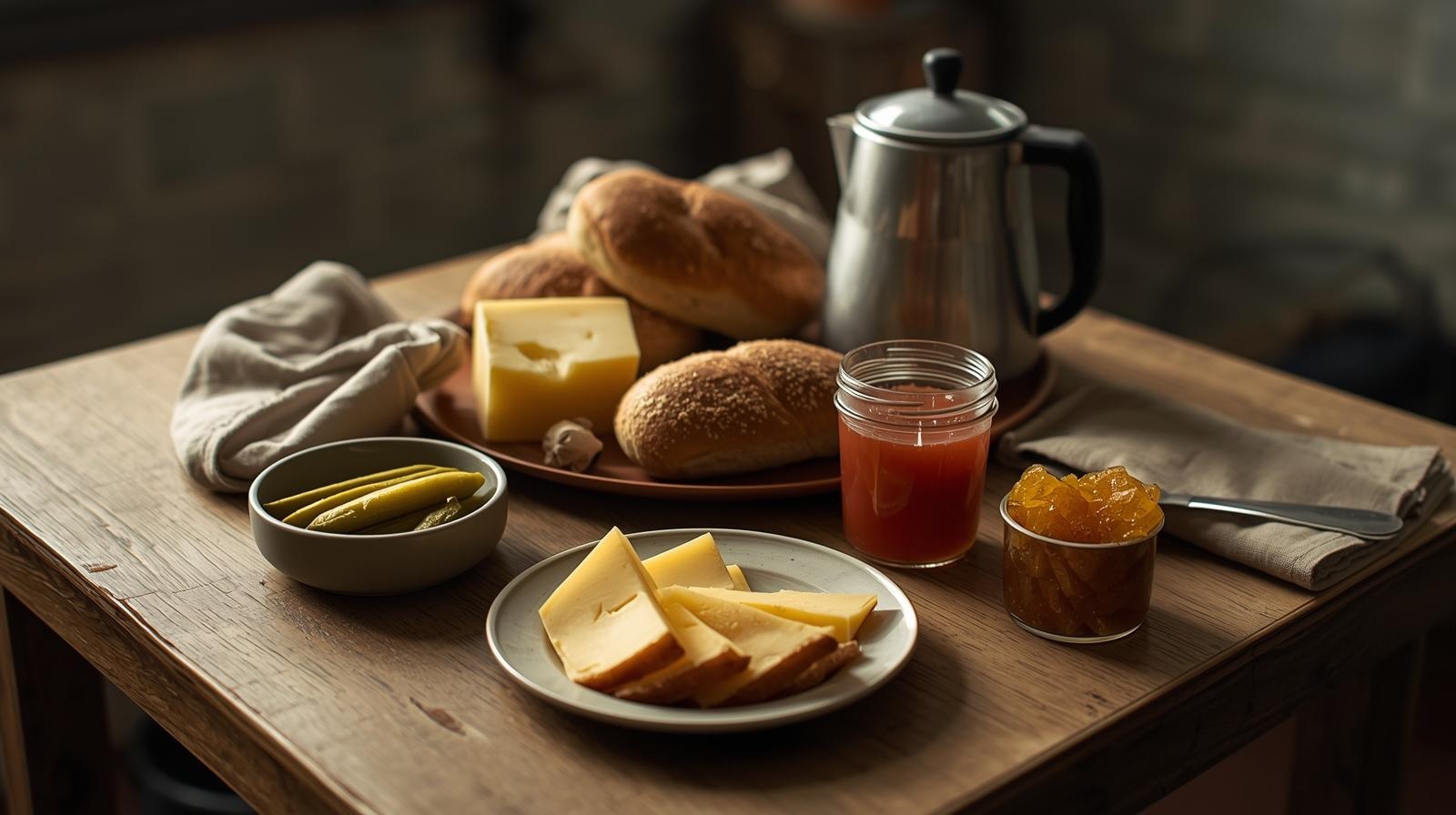
“Pickles, cheese, homemade buns, jam,” she listed. “And you have coffee or tea with it.”
Simple ingredients, familiar textures: tangy brine, soft warm bread, the sweet shine of jam.
A small spread that isn’t meant to impress you — it’s meant to bring you into the moment.
When she said, “Faspa is my fav,” I believed her instantly.


The Table in the Church Basement
Then the story shifted again, becoming deeper, softer.
“It’s usually what Mennonite families do after a funeral,” she said.
“You have faspa in the church basement after the burial.”
In my minds eye, I could see it clearly — a long table covered with modest plates, quiet conversations, hands wrapping around warm mugs. A whole community gathered not to distract themselves from grief, but to meet it together. Food not as comfort food, but as comforting presence.
In Filipino culture, we have the lamay and the after-burial gathering at a family home.
In many Asian families, there are soups and breads offered during mourning.
In Catholic homes, there is always coffee.
In all cultures, there is, in some form, a table.
Our table may look different, but the intention feels the same.
Is There a Filipino Equivalent?
I asked Jelena whether she thought Filipinos had something like faspa.
She said, “I’m curious too. You must have a word for it.”
Maybe we do — not a perfect mirror, but a cultural parallel.
There’s merienda, our mid-afternoon snack.
There’s hapúnan, the later meal.
And in many households — maybe in yours too — there is that unspoken moment when someone puts out coffee and pan de sal without announcing it. A quiet gathering, unplanned, but somehow expected.
Like faspa, merienda is not about hunger.
It’s about rhythm.
It’s about gathering for no reason except that the day feels better when shared.
What We Carry Forward
What struck me most wasn’t just the recipes or the customs, but how naturally we moved between cultures.
Between taco memories and soup traditions.
Between Filipino food identity and Mennonite family practice.
Between what my people pass down and what her people preserve.
This is Canada’s food landscape:
A Filipino asking a Mennonite about family dishes.
A friend offering to photograph her mother’s worn recipe book.
Two cultures discovering that they share an instinct — that food is how we stay connected.
Some traditions are loud and celebratory.
Some are quiet and unassuming.
Faspa is the kind that whispers.
And maybe that’s why it stays.
A Moment Worth Remembering
I’m not Mennonite, but the way Jelena described faspa made me feel like I had been invited to the table. It reminded me that the most meaningful food moments are not always the most elaborate. Often, they are the ones made from pickles, cheese, buns, jam, and coffee. The ones that happen between the planned parts of the day. The ones that hold families gently.
Faspa is many things — ritual, rhythm, remembrance.
But for me, it has become something else too:
A reminder that every community has its own way of saying,
“Come sit. Rest. Eat with us.” And that might be the generational recipe worth passing down.

Leave a Reply