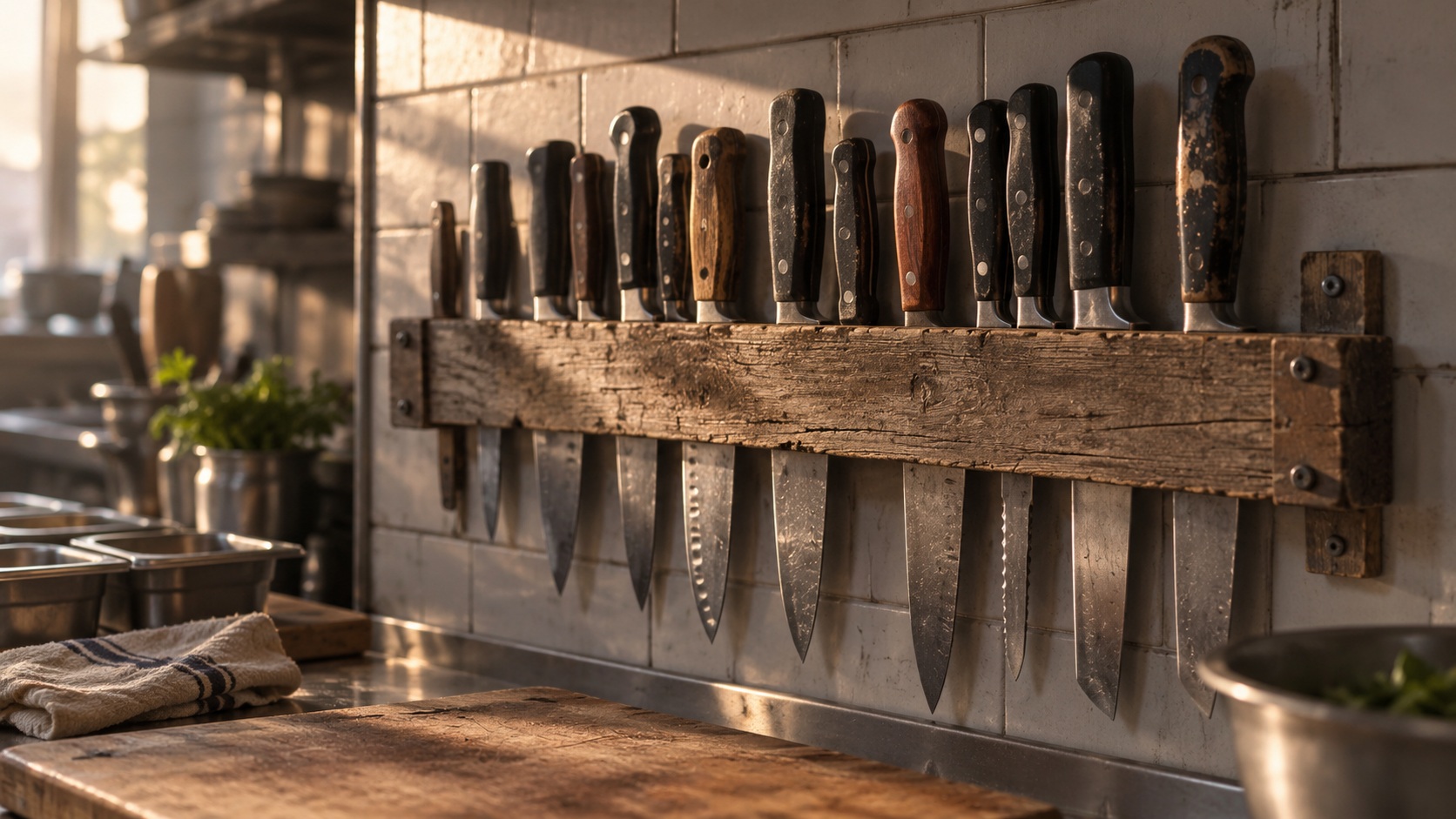
Before I owned a chef’s knife, I learned to respect the one everyone used.
My first job as a cook started at four in the morning at Perkins Family Restaurant.
Four. In the morning.
I was a prep cook, and one of my first tasks was chopping onions. My supervisor, Bobby Brown, took a chef’s knife off the wall and handed it to me. Yellow handle. Big, shiny blade. I remember looking at it and thinking it was a little scary.
It belonged to the prep area. Whoever was working there used it. This was well before I discovered that chefs carried their own bags of tools, and much longer before I bought a knife of my own.
That morning, I had the shared knife and the onions.
Bobby demonstrated how sharp it was by shaving a tiny piece off his fingernail. It came away with no effort. That demonstration has stayed with me, although I wouldn’t pass it along as a way to test a blade.
He sanitized the knife afterward. That was part of the lesson, too. Before I had cut anything, I was being taught that handling a knife included looking after it and keeping it clean.
Then he showed me how to cut the onion.
I remember the flat of the blade against my knuckles, guiding the movement as I brought it down slowly. Every cut required a decision. Where were my fingers? Where was the blade? How far should I move my hand?
There was nothing automatic about it.
When you’ve been cooking for years, it’s easy to forget how much attention those first movements take. You’re learning how to hold something that can hurt you while trying to do a useful job with it. Even chopping an onion feels like a lot to keep track of.

Getting comfortable
Repetition changes that.
You cut, then cut some more. Over enough prep shifts, the movement becomes familiar. You stop having to think through every part of it. Your hand knows the handle. You become comfortable with the blade.
The attention still needs to be there.
I learned that later, on a separate occasion, while cutting romaine lettuce. I was still using a shared kitchen knife. Owning my own was a long way off.
I was rushing through an order.
As cooks, we’re taught to be efficient. There’s work to get through, and you want to keep things moving. That day, I pushed faster than I should have.
I cut my hand.
Then I was in a coworker’s car with a bleeding hand, heading to the emergency room to get stitched up.
Never again will I cut myself.
Never again will I cut myself.
I said it over and over.
That was the day the difference between working efficiently and rushing became painfully clear to me. I knew how to make the cut. I had done it before. Knowing how didn’t protect me when I hurried through it.
Some things take the time they take. You can get better at them, become more organized, become more practised. You still have to pay attention to where your fingers are.

Before the chef’s knife was mine
Later in my kitchen career, I encountered chefs with their own bags of tools. Eventually, I got my own knife, too.
But my first lessons came from a knife that belonged to the kitchen. Every prep cook got to use it. I didn’t choose its handle, its size, or how it felt in my hand. It was the knife available, and I had to learn to work with it.
That’s where my relationship with the chef’s knife started: at four in the morning, with Bobby, some onions, and a yellow handle.
I remember how slowly I worked that first day. Years later, that’s the part of the lesson I appreciate most.
For more articles on people and culture in Kucina, find these stories here.

Leave a Reply